What Is a Security Risk Assessment and Why Your NSW Business Needs One
Featured Companies

Davlin Security
Davlin Security provides trusted security guards, mobile patrols and alarm response services for businesses and properties in Campbelltown.
Visit Website- 1. What a Security Risk Assessment Actually Involves
- 2. What the Assessor Examines
- 3. No Two Sites Share a Risk Profile
- 4. The Findings That Come Up Again and Again
- 5. How Often Should a Business Be Assessed?
- 6. Licensing: What to Check Before You Book
- 7. Frequently Asked Questions
- 8. How long does a security risk assessment take?
- 9. Do I have to buy anything afterwards?
- 10. My business is small. Is a formal assessment still worthwhile?
- 11. Will an assessment lower my insurance premium?
- 12. Find the Weak Points Before Someone Else Does
A security risk assessment finds the predictable weak points offenders rely on before someone else does. Here is what a professional assessment covers, what it most often finds, and how often NSW businesses should book one.
Most break-ins are not sophisticated. Somebody tries a door that should have been locked, walks past a sensor that should have been working, or uses a dark corner that should have been lit. The gaps that offenders exploit are remarkably predictable, which means a structured walk-through of your premises can find almost every one of them first.
That is precisely what a security risk assessment delivers. A professional from a licensed security services provider reviews your site, documents the weak points, weighs how likely and how costly each one is, and hands you a prioritised action plan before someone else finds them for you. For most NSW businesses it is the highest-value hour on the entire security calendar, and it frequently costs nothing at all when it forms part of a quoting process.
What a Security Risk Assessment Actually Involves
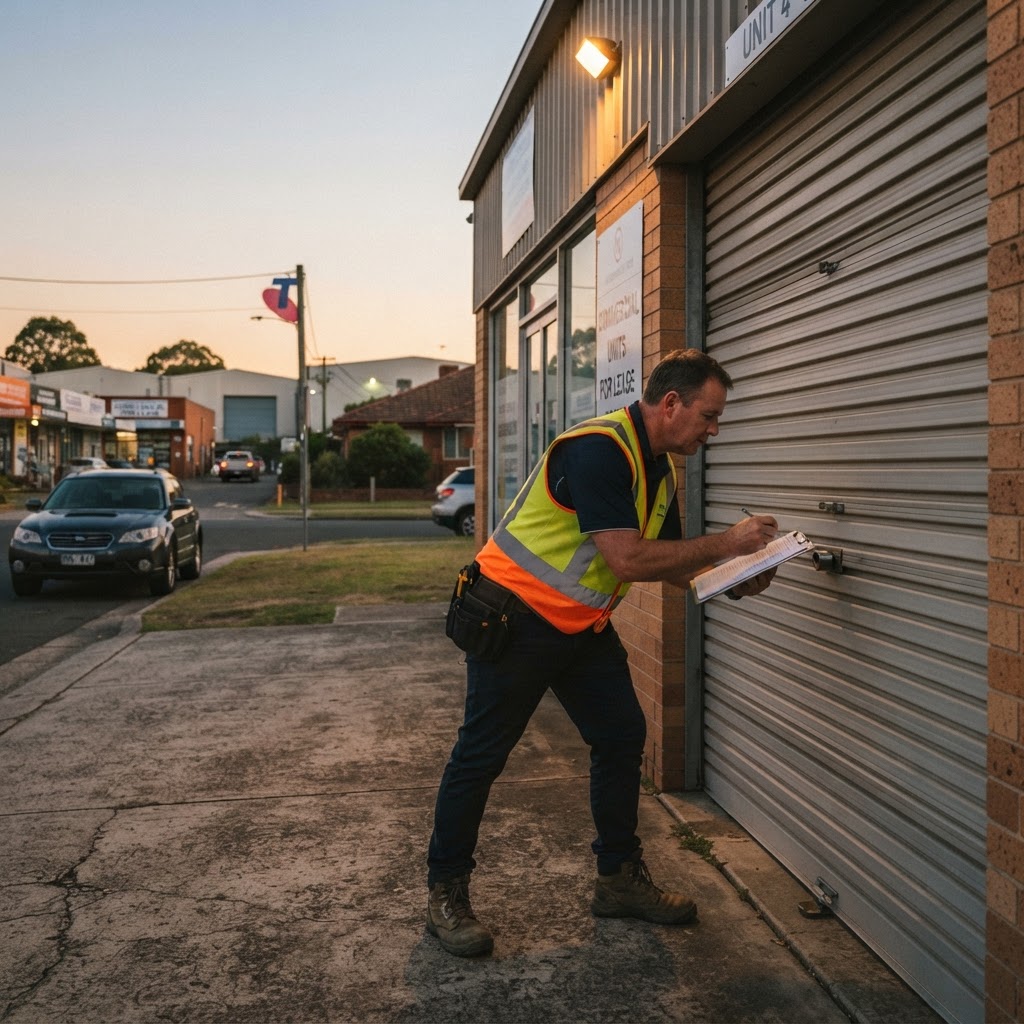
A proper assessment inspects your site from two directions at once: the way the property looks to you during a normal working day, and the way it looks to an offender at two in the morning. An experienced assessor walks the boundary and the building, tests and reviews the systems you already have in place, asks about staff routines, and documents every finding against realistic local risk.
The finished product should never be a generic report with a product catalogue stapled to the back. It should be a prioritised action plan: what to fix this week because it is cheap and urgent, what to budget for over the coming quarter, and what is genuinely fine exactly as it is.
What the Assessor Examines
Every site is different, but a thorough assessment always covers the same five territory areas:
- The perimeter. Fencing, gates, sightlines, blind spots and lighting, with particular attention to rear lanes, bin bays and delivery areas, since that is where most unlawful entries begin.
- Entry points. Front doors, rear exits, roller doors, windows and any loading dock that would give an offender time to work unseen.
- Existing systems. The age and condition of the alarm, whether it is actually monitored, CCTV security systems and camera placement, locks, key registers and access control.
- Routines. Opening and closing procedures, cash handling, stock deliveries and after-hours access, because these are the habits offenders learn to predict.
- Context. Location, incident history, what is happening at neighbouring premises, and the crime patterns actually recorded in your part of NSW.
Each finding is then rated for likelihood and consequence, and the recommendations come back in cost order. Most assessments surface two or three fixes that cost next to nothing yet close off a disproportionate share of the easy opportunity.
No Two Sites Share a Risk Profile
A shopfront on a busy retail strip, a warehousing unit on an industrial estate, a trades depot and a professional suite might all sit in the same postcode, yet they share almost nothing about how they get robbed. The retailer's risk is frontal and opportunistic. The warehouse is exposed after hours. The depot's exposure is tools in vehicles. The office's weak point is access control and untracked after-hours visitors.
This is why a national checklist downloaded from the internet will never fit. It cannot tell you which side of your building sees loitering after dark, or how recent incidents along your street should reshape your priorities. A local assessor works that out on the spot, walking the ground an offender would walk.
The Findings That Come Up Again and Again
Across thousands of assessments, the same handful of gaps recur:
- Motion-activated lighting missing over the entrances and delivery points offenders actually use
- Alarms that are armed but not monitored, which is just noise nobody is listening to
- Patrol visits that are not GPS-verified or reported in writing, so nobody can prove attendance
- No documented after-hours response plan covering who gets called, in what order, by whom
- Key control that has drifted over the years, with former staff and old contractors still holding keys
- Stock, tools and vehicles clearly visible from the street through open yards, windows or roller doors
None of these cost a fortune to remedy. All of them are precisely what an offender hopes you never get around to checking.
How Often Should a Business Be Assessed?
The rhythm that works for most businesses is once a year, plus three trigger events: immediately after any incident or near miss, after a fit-out, relocation or change of premises, and in the lead-up to long shutdown periods such as Christmas and New Year. Risk is never static, so the assessment should never be either.
Licensing: What to Check Before You Book
Security work in NSW is licensed under the Security Industry Act 1997 and administered by SLED, the Security, Enforcement and Licensing Directorate. Whoever assesses your premises should hold a current Master Security Licence, and the number should be verifiable in seconds on the SLED public register. Providers who do real alarm system installations and monitoring will produce their credentials without hesitation; anyone who hesitates has answered your question for you.
Frequently Asked Questions
How long does a security risk assessment take?
For most small and medium sites, somewhere between 45 minutes and two hours, covering the walk-through and a conversation about routines, incident history and what nearby businesses have experienced.
Do I have to buy anything afterwards?
No. The findings and the plan belong to you. Plenty of owners implement the basics themselves in the first week and only engage services for the larger items, such as monitoring or a patrol program.
My business is small. Is a formal assessment still worthwhile?
Small businesses usually benefit the most, because the findings tend to be inexpensive to fix: lighting, locks, key control and a monitored alarm. The plan simply scales to the size of the operation.
Will an assessment lower my insurance premium?
No honest provider will promise that. But documented risk-reduction measures count in underwriting conversations and make any subsequent claim far cleaner, so it is worth asking your insurer directly which measures they rate.
Find the Weak Points Before Someone Else Does
A risk assessment is inexpensive, fast and frequently free when it forms part of a quote. The only real question is whether the weak points are found by you, or demonstrated to you on a Monday morning. Book an assessment with a licensed NSW security firm this week and make sure it is the former.

Written by
Susan Blenman
SEO Analyst
Susan Blenman has worked in the security industry since 1993, sharing trusted insights and real-world expertise on security systems, technology, and protection strategies.
Related Articles
Sponsored

Ajax Alarm Systems: Wireless, App-Controlled & Pet-Friendly Security
Smart, Stylish Security for Homes & Small Business Protect what matters with the Ajax wireless alarm ecosystem—fast to install, easy to use, and ready for smartphone control. Choose pre-built kits or build your own with motion, door/window, glass break, sirens, keypads and more.

Protect Your Property After Hours
Keep your business, site or facility secure with professional mobile patrols from Partisan Protective Services. Our trained security officers provide visible deterrence, scheduled checks and rapid response to help reduce theft, vandalism and unauthorised access.

Bosch Solution 6000 Security
Ideal for Larger home or Businesses