What Security Guards Check During an Overnight Shift in NSW
Featured Companies

Sentinel Security Services
Sentinel Security Services provides licensed security guards, mobile patrols, alarm monitoring and CCTV solutions for businesses and residents across Sydney and surrounding areas. 24/7 protection, licensed and insured, Sydney-wide coverage.
Visit Website- 1. Perimeter and Entry Points Come First
- 2. The Interior Sweep: Doors, Lights and Signs of Presence
- 3. Alarm and Camera Systems Get Verified, Not Assumed
- 4. Varying the Route Is a Security Decision
- 5. Every Check Gets Written Down
- 6. When Something Isn't Right
- 7. Frequently Asked Questions
- 8. How often does a guard check the site during an overnight shift?
- 9. Is one guard enough for an overnight shift?
- 10. What's the difference between a static guard and an overnight patrol?
- 11. Do guards check alarms and CCTV, or just walk around?
- 12. Will a guard actually confront someone on my property?
- 13. Know Exactly What You're Paying For
A professional overnight security shift is a structured inspection routine: perimeter, entries, interior sweep, alarm and camera checks, written reports and escalation. Here's what licensed guards actually check.
When a business locks up for the night, most owners picture "security" as a guard sitting near the front door until sunrise. In practice, a professional overnight shift is a structured inspection routine: a documented sequence of checks, repeated in varying order, recorded every time, with escalation the moment something isn't right. Done properly, it turns a static presence into an active detection system.
So what does a licensed guard on an overnight shift actually check? Here's the honest breakdown, whoever you engage.
Perimeter and Entry Points Come First
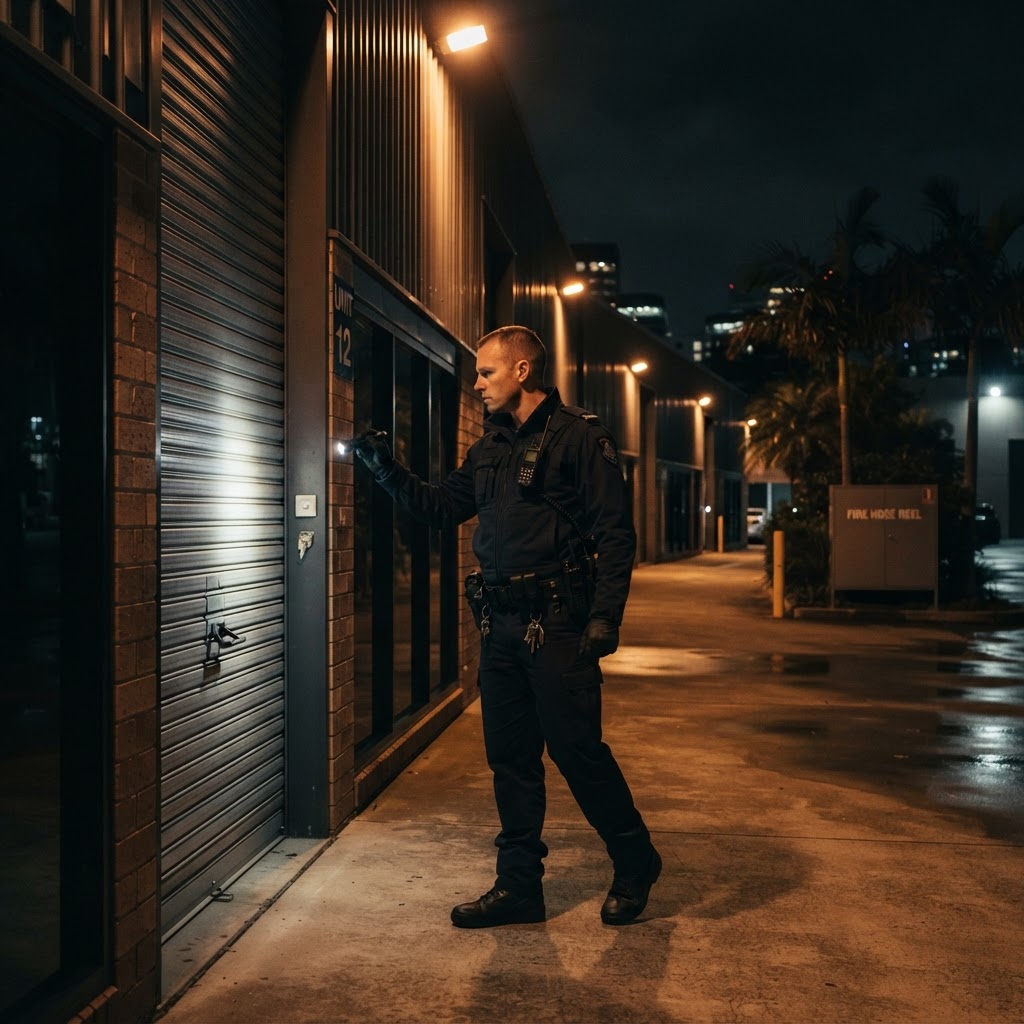
Every shift starts with the outside of the site. The guard walks the full perimeter, looking for the quiet signals of attempted or prepared entry:
- Fences, gates and walls — cut mesh, bent palings, padlocks that have been tampered with, gates left unsecured
- Doors and roller shutters — pry marks around frames, damaged locks, doors that don't close or latch cleanly
- Windows and skylights — cracked or removed panels, glazing that has been cut and replaced
- Roof access and ladders — one of the most commonly overlooked entry routes on commercial premises
- Parking and loading areas — vehicles that shouldn't be there, trailers left loaded, dock doors not properly secured
The point of checking the perimeter first is simple: if someone has already made entry, you want to know before you walk the interior, not after.
The Interior Sweep: Doors, Lights and Signs of Presence
Inside, the inspection covers every accessible space on a rotation, not just the front desk:
- Fire exits and stairwells — the classic blind spot. An unlocked or propped fire door is the single most common vulnerability found on commercial sites, and the one offenders use most
- Internal doors — offices, storage rooms, server and communications rooms, all locked and undisturbed
- Lighting — failed bulbs inside and out, because a dark corner tonight is a break-in opportunity next week
- Sensitive areas — cash handling points, safes, stock rooms, IT infrastructure: checked for disturbance, not just closed
- Signs of presence — moved stock, discarded packaging, unfamiliar items, anything that suggests someone has been inside who shouldn't have been
Alarm and Camera Systems Get Verified, Not Assumed
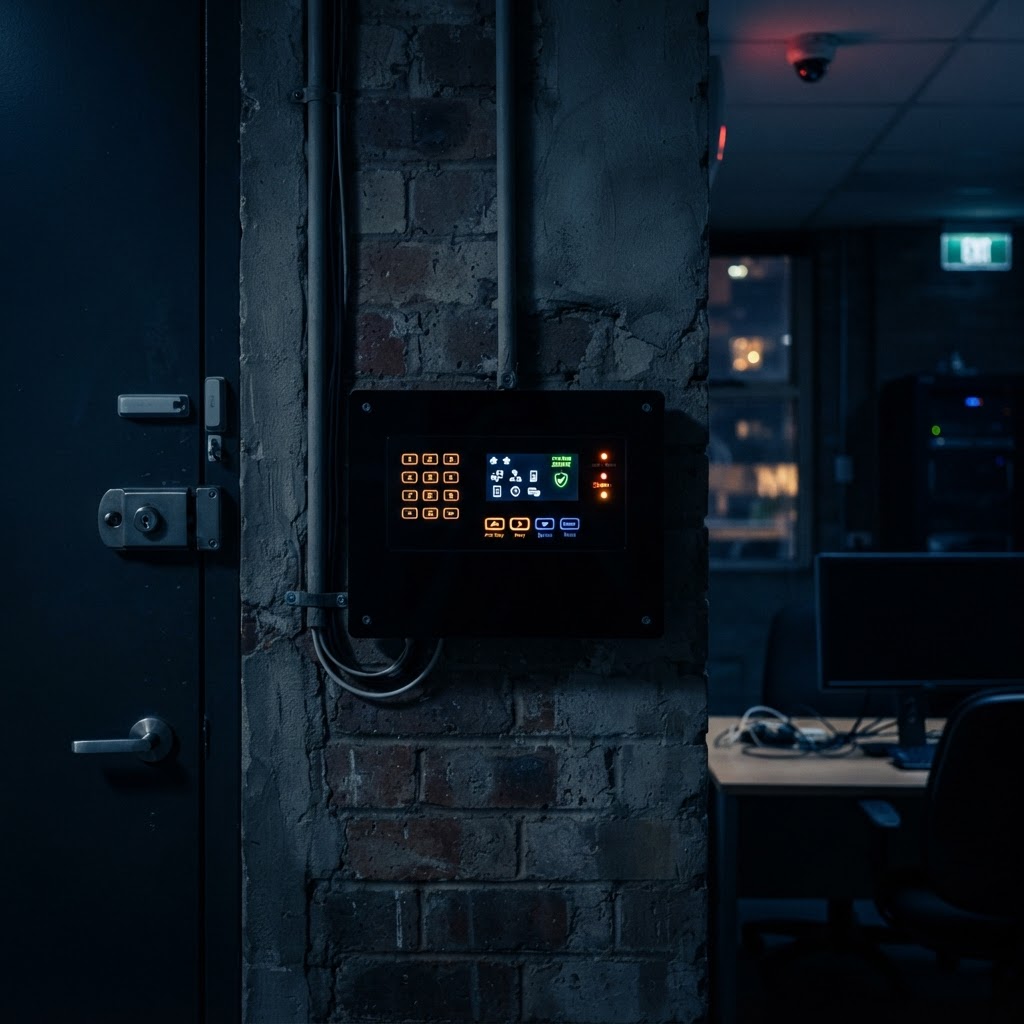
A guard on overnight duty doesn't assume the alarm panel is armed because it was armed yesterday. They check the panel's status directly, confirm zones are showing secure, and walk key camera positions to confirm lenses are clear, recording is running and nothing has been knocked out of alignment. If the site has a monitoring plan, the guard knows the escalation path and has the contacts to action it at 2am, not at 9am when the office opens.
Varying the Route Is a Security Decision
A professional overnight shift doesn't follow the same circuit at the same times, because a predictable patrol is just a schedule someone can wait out. Good providers vary both the order of checks and the timing of rounds. The guard still covers every point on the checklist every shift, but an observer can't learn when the loading dock gets checked and plan around it.
This is also why a static guard and a patrol program are complementary rather than interchangeable. Licensed security guards provide continuous presence at one site, while mobile patrols add unpredictable external inspections across multiple sites. Many NSW businesses run both, with the static presence concentrated on the highest-risk hours and locations.
Every Check Gets Written Down
The paper trail is half the value of an overnight shift. A professional guard produces a shift report that records:
- Time-stamped and GPS-verified patrol points, proving coverage rather than asserting it
- Every fault found and what was done about it: the fire door secured at 1:40am, the failed light reported for morning repair
- Any incidents, people moved on or contacts with police, documented while the details are fresh
- The handover: what the day team needs to know before they unlock
For the business, those reports feed three consumers at once: insurers who want evidence of proactive protection, repair scheduling before a fault becomes a breach, and any police report that needs a clean, timestamped record.
When Something Isn't Right
A guard who finds an open door, fresh damage or someone on site doesn't improvise. Licensed guards follow a documented escalation plan: secure their own safety first, verify what they're seeing, contact the control room, keyholders or police per the site plan, and record everything. In NSW that judgement sits inside a licensed framework: guards work under the Security Industry Act 1997, administered by SLED, and the provider holding the contract must carry a current Master Security Licence — checkable on the SLED public register in under a minute. Checking both is the fastest way to know your overnight coverage is professional.
Frequently Asked Questions
How often does a guard check the site during an overnight shift?
A well-run program varies the timing deliberately, but every checkpoint is covered every shift, typically on multiple rounds through the night, with the pattern recorded in the shift report so coverage can be proven rather than presumed.
Is one guard enough for an overnight shift?
For most single-site businesses, yes. Larger sites, multi-building industrial estates or locations with a history of incidents may justify additional coverage, and a proper risk assessment will tell you honestly either way.
What's the difference between a static guard and an overnight patrol?
A static guard stays on your site, providing continuous presence and interior checks. A mobile patrol makes external inspections on a varied schedule at a lower cost. Many businesses use both, sized to their risk profile and budget.
Do guards check alarms and CCTV, or just walk around?
Both. Verifying the alarm panel status and camera function is part of the routine, because an overnight presence is only as useful as the detection systems behind it. Faults get logged and reported, not quietly ignored.
Will a guard actually confront someone on my property?
A licensed guard can direct trespassers to leave, document incidents and escalate to police per your site plan. The emphasis is on presence, deterrence and evidence, not confrontation, which keeps your people, your property and your legal position safe.
Know Exactly What You're Paying For
An overnight guard shift is a documented inspection program with a person at the centre of it: perimeter, entries, interior, systems, records. When a provider can't tell you what their guards check on each shift, that's your answer. Ask for the checklist in writing, ask to see a sample shift report, and verify the Master Security Licence before you commit to anything.

Written by
Susan Blenman
SEO Analyst
Susan Blenman has worked in the security industry since 1993, sharing trusted insights and real-world expertise on security systems, technology, and protection strategies.
Related Articles
Sponsored

Ajax Alarm Systems: Wireless, App-Controlled & Pet-Friendly Security
Smart, Stylish Security for Homes & Small Business Protect what matters with the Ajax wireless alarm ecosystem—fast to install, easy to use, and ready for smartphone control. Choose pre-built kits or build your own with motion, door/window, glass break, sirens, keypads and more.

Protect Your Property After Hours
Keep your business, site or facility secure with professional mobile patrols from Partisan Protective Services. Our trained security officers provide visible deterrence, scheduled checks and rapid response to help reduce theft, vandalism and unauthorised access.

Bosch Solution 6000 Security
Ideal for Larger home or Businesses