Night-Time CCTV: Recording Movement Isn't the Same as Identifying Someone
Featured Companies

CTC Communications
Shop online with CTC Communications for trusted security systems, CCTV & intercoms Australia-wide. Great prices, expert support & fast delivery.
Visit Website- 1. Why night-time image quality matters
- 2. Recording movement is not the same as identifying someone
- 3. Infrared, full-colour or hybrid light?
- 4. When infrared night vision makes sense
- 5. When full-colour night vision makes sense
- 6. How hybrid-light cameras work
- 7. What causes motion blur at night
- 8. Lighting is the biggest factor you can control
- 9. Placement: angle, height and distance
- 10. Test the recorded footage after dark
- 11. Frequently asked questions
- 12. Do security cameras work in complete darkness?
- 13. Is colour night vision better than infrared?
- 14. Will a 4K camera give me clearer footage at night?
- 15. Can a standard CCTV camera read number plates at night?
- 16. Need clearer footage after dark?
A camera can prove someone was there and still leave you without usable detail. How infrared, colour and hybrid-light cameras perform after dark.
The best CCTV camera for night-time security depends on the lighting around your property and the level of detail you actually need to capture. Infrared cameras can record in apparent darkness, full-colour cameras need available light or built-in visible illumination, and hybrid-light cameras offer both. What matters most is whether the system still captures usable detail when someone is moving through the frame.
Why night-time image quality matters
A camera can show that someone entered your property without capturing enough detail to be useful afterwards. Poor lighting, motion blur, glare and unsuitable placement can all reduce the value of recorded footage.
A bright picture of an empty driveway does not mean the camera will capture a clear face when someone walks across it. Footage should be judged with moving subjects, after dark, before you rely on it.
Recording movement is not the same as identifying someone
Most cameras will happily tell you that something happened. Motion detection triggers, an alert arrives, and the recording shows a shape crossing the driveway. That is detection, and it is genuinely useful, because it tells you when to look.
Identification is a different standard. To make out a face, a clothing colour or a vehicle detail, the camera needs enough light, an exposure fast enough to freeze movement, enough resolution at the distance the person actually is, and a viewing angle that shows the subject rather than the top of their head.
If any one of those falls short, the footage tells you less. When they all line up, you move from "someone was here" to footage that helps you understand who and what happened.
Infrared, full-colour or hybrid light?
- Infrared night vision — best suited to dark areas where visible lighting is unsuitable. Footage is black-and-white, so clothing and vehicle colours cannot be relied on.
- Full-colour night vision — best suited to entrances and areas where colour detail matters. It needs enough available light, or visible supplementary lighting.
- Hybrid-light cameras — best suited to properties that want both infrared and colour recording. Switching behaviour varies by model, detection features and settings.
When infrared night vision makes sense
Infrared cameras use illumination outside the visible spectrum, which lets a compatible camera record in darkness. They suit side passages, rear access points and areas where you would rather not have a light burning overnight.
Check the lens, the infrared coverage and the installation position. An advertised illumination range does not mean a face can be identified at that distance. Nearby walls, eaves and reflective surfaces can also bounce light back into the camera and wash out the picture.
When full-colour night vision makes sense
Colour footage carries extra descriptive detail, such as the colour of clothing or a vehicle. That makes it useful at front doors, business entrances and driveways.
Full-colour recording still needs light. Low-light sensor technology makes better use of whatever illumination is available, but a genuinely dark area needs an appropriate light source. If the camera uses built-in visible lighting, check that this suits the neighbours and the surroundings.
How hybrid-light cameras work
Hybrid-light cameras combine infrared and visible illumination. Depending on the model and configuration, a camera might use infrared for general night-time coverage and switch to visible light when it detects a person or vehicle.
That can deliver colour footage during an event while limiting continuous visible light overnight. Always check the individual camera specifications and how the switching is configured.
What causes motion blur at night
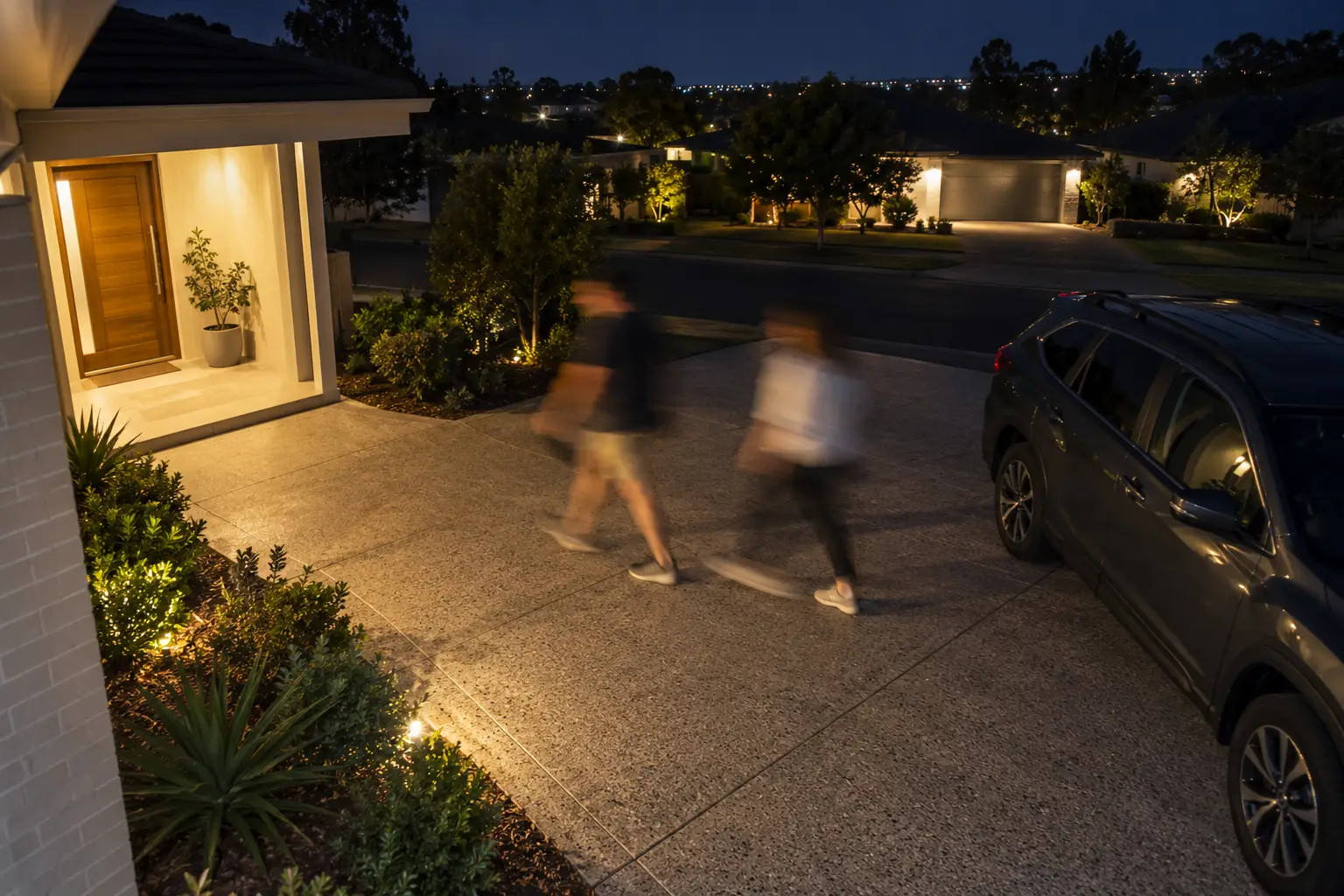 In low light, a camera may lengthen its exposure to brighten the picture. Static objects stay sharp while anything moving appears smeared. A faster shutter captures movement more crisply, but it needs enough light to keep the image usable, which is a balance between sensor performance, settings and illumination.
Adding megapixels alone will not fix this. Resolution, sensor performance, exposure, lighting and the distance to the subject all shape the result. In the image above, the house, the car and the driveway are perfectly clear, while the people walking through are no longer identifiable.
Lighting is the biggest factor you can control
Most night-time footage problems trace back to light rather than the camera. Ambient light from streetlights, porch lights and neighbouring properties is what many low-light cameras rely on, so a change to a nearby light fitting can change what your system captures.
Position cameras so the subject is lit from the camera's side rather than silhouetted against a bright doorway or headlights. Direct glare flattens detail and can leave the face in shadow even when the rest of the scene looks bright. Infrared reflection off a close wall, an eave or a cobweb produces the same effect.
Adding visible white light after dark is a real trade-off. It improves colour detail and can act as a deterrent, but it changes the look of the property overnight and is not appropriate in every setting.
Placement: angle, height and distance
A camera mounted high on a two-storey wall gives a great overview and a poor view of faces. Angle matters as much as lighting: for anything you might need to identify, the camera should be closer to eye level and reasonably close to where that person will actually be.
Distance works against detail. A wide shot that covers an entire frontage rarely resolves a face at the front gate. Where both overview and detail matter, two cameras, one for context and one for close capture, generally beat one camera asked to do both.
Think about what the camera sees at the moment someone is in the frame: is the approach path covered, is a face turned towards the lens, is a parked car or overgrown shrub in the way, and does the field of view leave a blind spot at the door itself?
Test the recorded footage after dark
Review what the system actually recorded rather than trusting the live view, which is often brighter and sharper than the stored result.
- Walk through each monitored area at night and watch the footage back.
- Check whether a face stays clear while a person is walking, not just standing still.
- Look for glare from lights and for areas the camera misses entirely.
- Check the recorder settings, because resolution, compression and frame rate all affect the detail retained.
- Keep lenses clean and remove cobwebs, which reflect infrared light and blur the image.
Read the full guide to choosing CCTV cameras for night-time security.
Frequently asked questions
Do security cameras work in complete darkness?
Compatible infrared cameras can record using infrared illumination. Colour cameras need available light or visible supplementary lighting.
Is colour night vision better than infrared?
Colour footage carries extra descriptive detail, while infrared is useful where visible lighting is unsuitable. The better choice depends on the location and on the quality of footage each option produces there.
Will a 4K camera give me clearer footage at night?
It can provide more image detail, but resolution alone does not guarantee better night footage. Lighting, sensor performance, exposure and placement still decide the outcome.
Can a standard CCTV camera read number plates at night?
Sometimes, but headlights, reflective plates and movement make it difficult. Reliable plate capture usually needs a dedicated camera with suitable positioning and settings.
Need clearer footage after dark?
Security Insights works with installers who match cameras, lighting and recording equipment to the property rather than to a spec sheet. If your current system records movement but not detail, the fix is often placement and lighting rather than more megapixels.

Written by
Susan Blenman
SEO Analyst
Susan Blenman has worked in the security industry since 1993, sharing trusted insights and real-world expertise on security systems, technology, and protection strategies.
Stay informed
Get the latest security insights, guides, and company spotlights delivered to your inbox.
Related Articles


Sponsored

Ajax Alarm Systems: Wireless, App-Controlled & Pet-Friendly Security
Smart, Stylish Security for Homes & Small Business Protect what matters with the Ajax wireless alarm ecosystem—fast to install, easy to use, and ready for smartphone control. Choose pre-built kits or build your own with motion, door/window, glass break, sirens, keypads and more.

Protect Your Property After Hours
Keep your business, site or facility secure with professional mobile patrols from Partisan Protective Services. Our trained security officers provide visible deterrence, scheduled checks and rapid response to help reduce theft, vandalism and unauthorised access.

Bosch Solution 6000 Security
Ideal for Larger home or Businesses